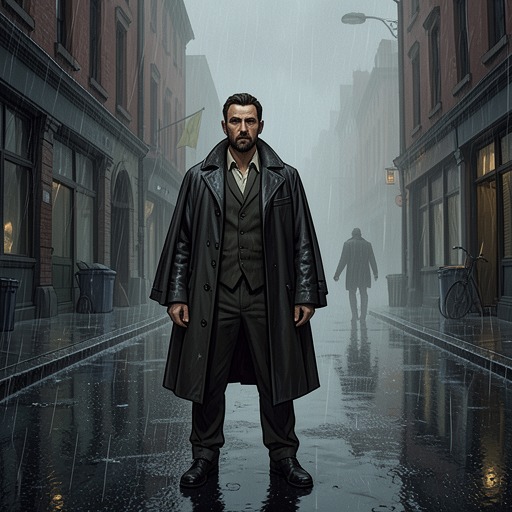
Julian Returns to the Aldaya Mansion and Finds Penelope and David's Tomb
The Shadow of the WindJulian’s return to the Aldaya mansion culminates in the discovery of Penelope Aldaya and David’s tombs, ending seventeen years of hope with proof that both are dead. The ruined house, already transformed into fiction in Julian’s novels, becomes the place where that imagined world gives way to an irreversible family history: Penelope and the child Julian had hoped to find lie buried together, while Julian must reckon with what he was never told and with the consequences of his own choices.
Background and the Search for the Past
The visit follows a trail of records and recollections that has made Julian’s supposed death—and the identity attached to it—uncertain. An envelope addressed to him bears Penelope’s name and the return address of the Aldaya residence on Avenida del Tibidabo. Its postmark is 18 October 1919. The opened seal and the letter’s old paper and ink make a private message from the past materially present, linking Julian’s search to the mansion before he returns there in person.
A later account of the morgue records shows how official documentation could obscure rather than establish identity. In September 1936, a body brought to the autopsy department was accompanied by a passport and a book; the passport named the dead man Julian Fortuny Carax, born in Barcelona in 1900, and indicated that he had entered Spain through La Junquera a month earlier. The reported cause of death was a close-range gunshot wound. The account also describes a policeman overriding the morgue’s identification rules, signing the registration form as the final authority on who the dead man was, and ordering burial in a common grave at Montjuic. This history of manipulated identification forms part of the larger uncertainty surrounding what happened to Julian and what the city’s records can be trusted to say.
That uncertainty is made more concrete by the account of Miquel Moliner’s death. After Miquel was killed, his body was left in an alley in the Raval quarter; by the time it reached the morgue, it had been dead for two days. Because he had left his papers at home, the only identifying documents found were a disfigured passport in Julian’s name, alongside a copy of The Shadow of the Wind. The police recorded Miquel as Julian Carax. At the morgue, Fumero recognized Miquel but signed the forensic report confirming the false identity and ordered the body taken to a common grave at Montjuic. The forged public ending of Julian’s story and the private search that brings him back to the Aldaya house thus meet in a record built on deliberate deception.
The Return to the Mansion
As evening falls, Julian and Nuria travel by tram across Barcelona, passing along Via Layetana and Paseo de Gracia before continuing toward Avenida de la Republica Argentina. Julian watches the streets in silence, as though afraid of losing the city while moving through it. He takes Nuria’s hand and kisses it; an elderly passerby, accompanied by a little girl dressed in white, mistakes them for an engaged couple. The brief encounter offers an image of ordinary shared life just before the journey returns Julian to the site of his buried past.
They approach the abandoned mansion from the back, near its tennis courts. Its chained main entrance and padlock bar the way in. Julian uses acid on the lock, then breaks it with a cobblestone and enters with a lighter. The house is not merely a location from his history: its changing, sinister form had already been recast in The Red House, where it becomes a labyrinth of corridors, galleries, attics, and stairs. The return therefore brings together the real building and the fictional spaces through which Julian has repeatedly given it shape.
Inside, the distinction between open and closed rooms directs the search toward one exceptional barrier. The other doors have been left open and stripped of their locks and handles, but a narrow corridor leads to a doorway sealed behind a rough wall of red bricks. Julian stops at the sight of it. Rather than leave with Nuria, he begins to break through, forcing an opening with repeated blows until he can remove enough bricks to uncover a wooden door carved with angel motifs. He touches the carvings before pressing the door open. The hidden entrance converts the mansion’s physical architecture into an obstruction between Julian and the fact he has been seeking.
The Tombs and Recognition
Beyond the carved door, a staircase descends into a sealed, subterranean room. Julian goes down despite the fear that Nuria sees in his face. At the bottom, two marble tombstones stand side by side, joined in the scene by their placement and described as chained together. Their inscriptions identify the dead: Penelope Aldaya, whose dates are 1902–1919, and David Aldaya, who died in 1919. The names and dates settle what hope and rumor had left unresolved. Penelope died in the year the old letter was postmarked, and David’s grave confirms the existence and death of the child Julian had never known he had lost.
The discovery is a sudden recognition rather than a gradual revelation. Julian had waited seventeen years for Penelope, but the tombs show that she and their son had been dead throughout that imagined future. The narrator reflects that Julian’s life seemed to collapse in seconds: the hoped-for reunion, the family he might have found, and the life he had pictured were all made impossible at once. He stands speechless and trembling, unable to respond with tears. Nuria embraces and kisses his forehead, but his stillness does not resolve into comfort.
Consequences and Significance
Nuria initially interprets the discovery as a possible release. She hopes Julian can now understand that nothing remains to hold him in Barcelona and that they can leave together. She even wants to believe that Penelope has finally forgiven them. That hope does not match Julian’s response. When the lighter is relit, his eyes appear empty, and Nuria reads his anger as directed at several people and at himself: at her for deceiving him, at Miquel for having tried to give him a life that now feels like an open wound, and most of all at himself as the man who believes he caused the calamity.
The tomb scene exposes the limit of recovery through evidence. Letters, passports, and morgue records can restore names and dates, but they cannot restore the people whose lives those documents describe; moreover, the official records themselves have been manipulated. The sealed room supplies a truth that had been hidden, yet knowing it does not bring Julian the future he expected. His return makes the mansion’s buried history undeniable and turns his long wait into grief and self-accusation. The house that had furnished his fiction now contains the fixed, material ending that fiction could not undo.